Field note
The Fool and the Tao: Walking Toward the Cliff Without Pretending
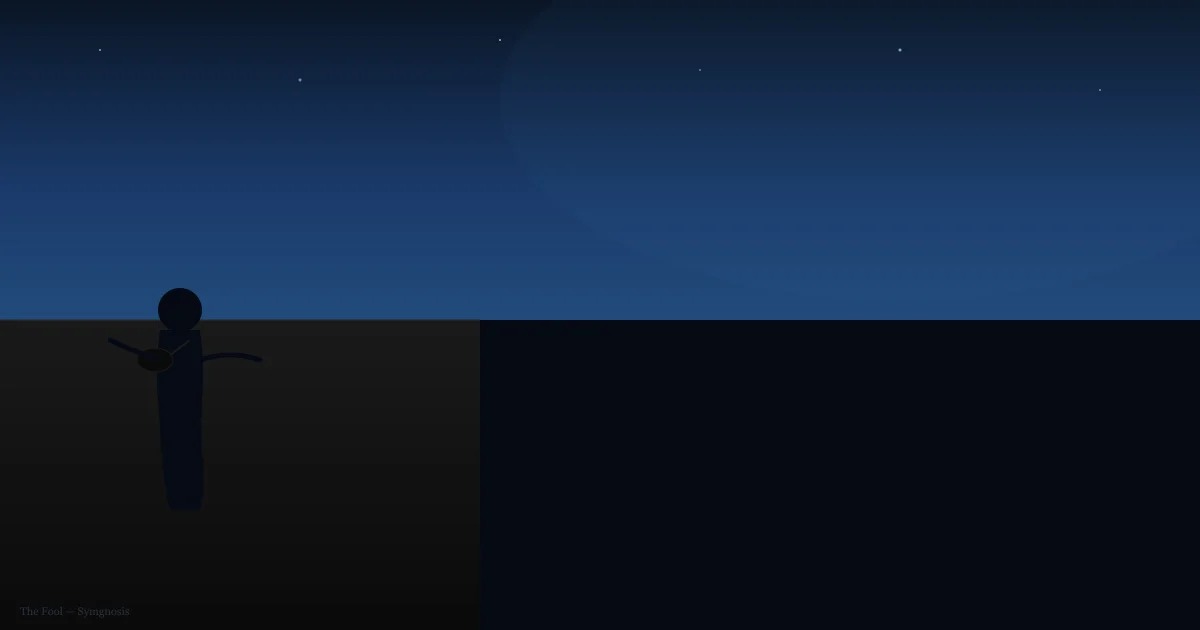
The Rider-Waite Fool stands at the edge of a cliff, foot poised over empty air, a small bag slung over his shoulder, eyes fixed on the sky. Most readers treat this as a picture of naivety — the naive person who doesn’t see the danger ahead. That reading is not wrong, but it stops too early.
The Uncarved Block
In the Zhuangzi, 朴 (pǔ) — the uncarved block — is the state before names and categories are imposed on things. Before something is labeled “good” or “bad,” “safe” or “dangerous,” it simply is. The uncarved block does not reject the cliff. It does not fear the fall. Not because it is ignorant of the fall, but because the distinction between falling and not-falling has not yet been carved.
The Fool’s posture is precisely this: foot above the void, not leaning back, not lurching forward. In Daoist terms, the Fool is the person who has returned to pǔ. The categorical mind — the part that calculates risk and plots safe routes — has gone quiet.
Three Resonances
1. No destination. The Fool carries a bag, but there is no stated destination on the card. The Taoist sage moves with the dao — the way — not toward a destination. The Fool’s “way” is the walking itself. The path is not something to be followed; it is what happens when you stop plotting.
2. The dog at the heel. In many decks, a small dog trots at the Fool’s heels, sometimes interpreted as the instinctual self, or loyalty, or the call of the known world. In the Zhuangzi parable of the useless tree, the sage is said to be sheltered by what ordinary people discard. The dog is not a warning. It is simply there — the ordinary self moving in the wake of the extraordinary one.
3. The cliff is not a threat. Most readings say the Fool is about to step off a cliff. But a more radical reading: the cliff is already behind him. He has already stepped off. Everything before this moment — the world of ledgers, credentials, five-year plans — is the thing he has left. The cliff face is not an obstacle. It is the open air he has already chosen.
Bringing It to a Single-Card Draw
When this card appears in a single-card draw, the question to sit with is not “should I be reckless?” It is: Am I treating this situation as if I already know the shape of the ground beneath me?
If the answer is yes — if you have a plan, a prediction, a certainty — the Fool asks you to return to the uncarved block. Not to abandon intelligence, but to let the pǔ state precede it. What is the situation, before you named it? What does it look like when you stop calling it a problem?
The Tao that can be told is not the eternal Tao. — Laozi, Tao Te Ching, verse 1
The Fool is the card before the naming. Before you say this is a crisis, this is an opportunity, this is a mistake — there is only the open sky, and the step that is already being taken.
Draw your cards and sit with a reader who speaks in this register: Draw with the Hermit — or choose another voice from the Reading Hall.